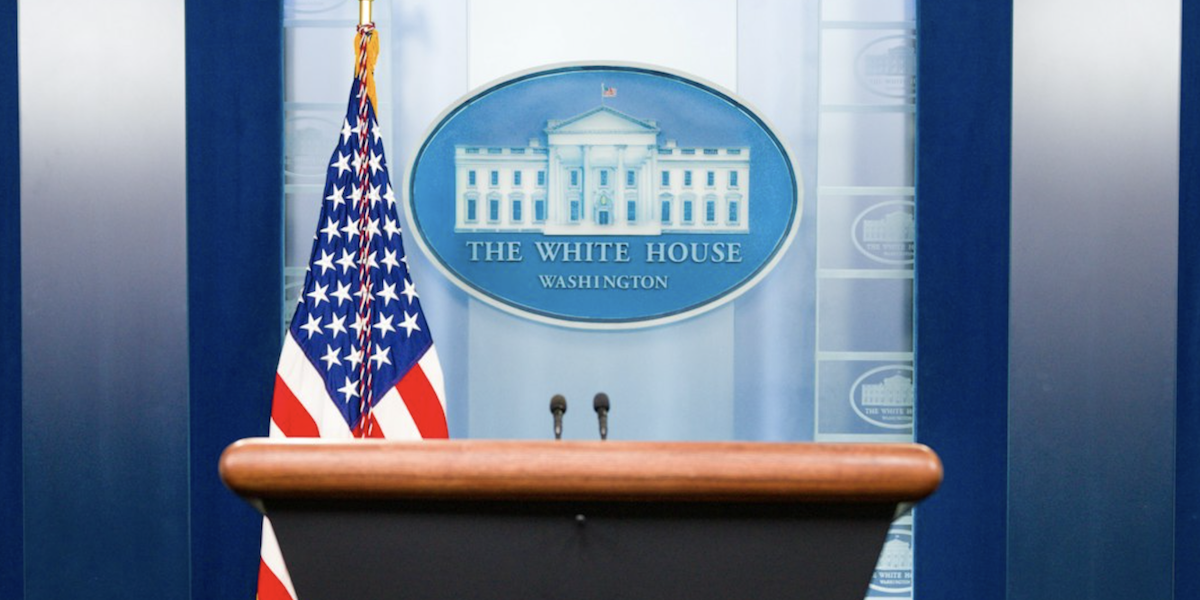
For decades, diplomatic correspondents covering Washington relied on the State Department as their principal source of foreign-policy news. While the White House has always set the broad direction of U.S. foreign policy, the department traditionally served as the government’s day-to-day diplomatic voice. Not anymore.
Today, most diplomatic news comes out of the White House — and not simply because Secretary of State Marco Rubio also serves as national security adviser. It’s hardly a secret that the State Department has been sidelined to an extent unheard of in recent history.
That reality has upended the journalistic routine of Washington’s diplomatic correspondents — both American and foreign. The regular press conferences, briefings and interviews the State Department provided for decades are all but gone, said reporters who have covered the department for years.
“The decision-making and the communications have been overwhelmingly White House-driven,” said Shaun Tandon, State Department correspondent for Agence France-Presse — though not in ways that help reporters do their jobs. The president’s social-media posts have become the main news source, at the expense of more traditional forms of news-gathering.
“Instead of attending briefings, for example, you are on the edge of your seat looking for social media posts, which is quite different,” Tandon said. “Obviously, that’s not the way we want to do it. Anybody can look at social media, but our goal as journalists is still to do things in depth and find contacts who can flesh out the details.”
Even though the White House holds more briefings than the State Department, they aren’t nearly as frequent as they were in the past — including during the previous Trump term.
“In the first Trump administration, we actually had more or less daily briefings, when Sarah Huckabee Sanders was the spokesperson,” said Nadia Bilbassy, Washington bureau chief for the Arabic news network Al Arabiya. “We’ve seen that completely change during the second administration. We rarely get a press conference with the president — what he calls a ‘press conference’ is basically access to the Oval Office, and even that’s been restricted for foreign reporters. We no longer have it the way we used to.”
On the rare occasions Trump does take questions, the way he decides which reporters to call on is “random,” Bilbassy said, in contrast to the longtime practice of the press corps agreeing among themselves in advance who will ask questions. Trump “will just pick out whoever he happens to see in the room, unless it’s someone he already knows from Fox News or similar outlets, whom he might call by name.”
With this system, many serious journalists miss out, because they can’t afford to wait around for hours to be allowed into the Oval Office — there rarely is a strictly observed schedule — “on the off-chance” Trump calls on them, Bilbassy said. That provides opportunities for “non-journalists or non-serious journalists” who may “ask a silly or unimportant question that doesn’t benefit the majority” of reporters in the room, she added.
In the past, when an administration announced a new foreign-policy initiative, a principal — the secretary of state or even the president — made an initial, big-picture statement, usually in person. In the most consequential cases, they might take questions from the press. “More often, lower-level officials with subject-matter expertise gave substantive briefings or one-on-one interviews,” said Nicholas Kralev, a former Financial Times and Washington Times correspondent and founder of the Washington International Diplomatic Academy.
Today, the decline in access for the media, its strained relationship with the administration and Trump’s often-erratic social-media posts that sometimes contradict his own officials make for very different diplomatic messaging, reporters said.
They noted that, instead of conducting in-depth interviews with policy experts to understand complex technical matters so they can explain them to the public in plain English, they have been reduced to deciphering social-media posts, often written hastily in the middle of the night. Some effectively reverse decades-old U.S. policies, completely bypassing the interagency process that governed policymaking for more than half a century.
“I have to keep notifications on for Truth Social, because often he will post something even the press secretary isn’t aware of,” Bilbassy said.
Ian Williams, president of the Foreign Press Association, a New York-based nonprofit, said that Trump’s advisers may believe they understand “which buttons to push” to influence his decisions. At the same time, however, he may be just as susceptible to outside voices, such as someone appearing on Fox News — “he will watch it and act on it,” Williams said.
Trump’s unpredictability has rattled the media as much as government officials around the world. Some have tried to justify it as a form of the “madman theory,” using uncertainty as a tool of diplomatic pressure. But Williams doesn’t buy that explanation. “What you see is what you get,” he said. “It’s completely capricious, which is worrying.”
Not all reporters mind the unpredictability. Georgy Olisashvili, U.S. bureau chief for Russia’s state-owned Channel One TV network, sees Trump’s behavior as “a huge advantage,” because it makes for more interesting and entertaining news.
“The Russian audience historically sees news from the United States almost like a show,” Olisashvili said. “You have many different characters, new storylines every day — diplomatic thrillers, war drama, family sagas. You can find almost any genre in stories about American political life. So this ‘show’ is really a good thing for a reporter, because you have a lot of material to work with.”
Even as unpredictability brings more professional satisfaction to some, Williams expressed concern about what it could mean for global stability.
“Could it lead to a world war?” he asked.